Q4 2025 Insurance AI Trends: Payers Go All-In on E2E AI Despite Tech Debt, Vendors Race to Simplify Integration

Related topics:
5 min read
Last updated:
Insurance IT, INNERLUXES has hands-on experience delivering risk-controlled AI automation for insurance underwriting and claims. Drawing on our recent client work and the key industry reports and events of Q4 2025, we highlight the insurance AI trends that will matter most over the next 12 months.
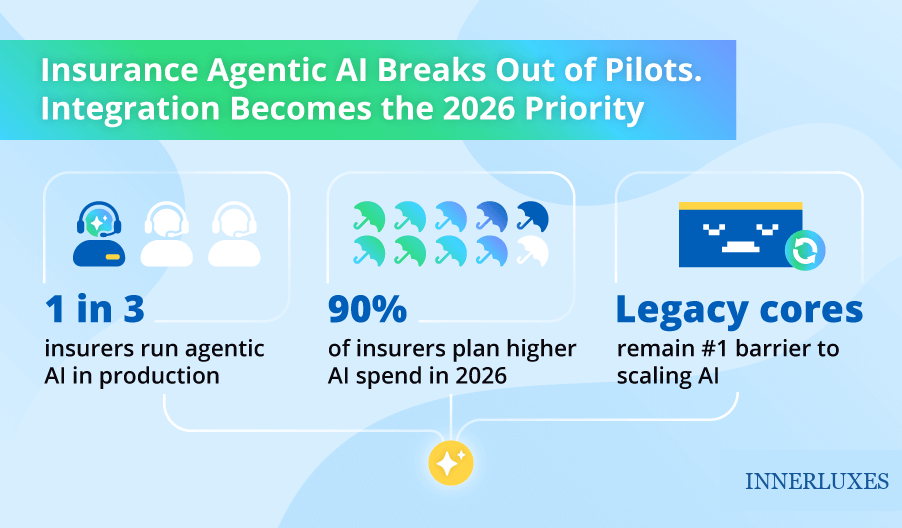
At a glance:
- Agentic AI is breaking out of pilot mode. In Q4 2025, one in three insurers reported at least one AI agent running in production.
- True end-to-end AI is still rare. Vendors pitch multi-task, enterprise-wide AI, yet most live deployments still cover isolated underwriting and claims tasks.
- Larger payers capture the most AI value, mainly thanks to automation scale, stronger organizational change management, and employee buy-in.
- Integration pains are reshaping vendor offerings. AI providers are moving toward plug-and-play, API-first, modular, and embedded solutions.
Demand Shifted From Task-Specific AI Toward Multi-Functional Agentic Systems
After two years of pushing AI into narrow use cases, insurers closed 2025 with one clear takeaway: isolated automation caps the impact of AI. Industry reports and executive sentiment landed on the same conclusion — meaningful AI value needs systems that coordinate intelligence both within and across core functions.
A Q3 2025 report by Boston Consulting Group (BCG) pointed out that concentrating on siloed AI use cases like submission intake or point fraud checks limits returns and slows scaling. The same thinking dominated the Insurance Transformation Summit 2025 and InsurTech Connect (ITC) Vegas 2025, the industry’s two flagship Q4 events. Insurance executives now see agentic AI as the next frontier, so in 2026, enterprise buyers will be hunting for agentic platforms that automate and orchestrate work across underwriting, claims, servicing, and customer experience.
In Q4 2025, vendors answered with multi-agent platform offerings built for full workflow coverage, positioning them as a practical way to scale AI across departments and systems. Most agentic AI products released after October 2025 explicitly targeted end-to-end processes across the entire insurance value chain (see the comparison below).
Established enterprise technology vendors set the pace. Sutherland introduced Insurance AI Hub, a suite of insurance-specific AI agents for life & annuity, group benefits, P&C, and specialty lines. Built in line with NAIC, HIPAA, and SOC 2 frameworks, the platform targets enterprise-scale deployment, and its modular architecture lets agents operate independently or in concert across the policy lifecycle. Early results showed up to 30% faster claims cycles, 12% lower leakage, and double-digit gains in claimant satisfaction, alongside better underwriting efficiency and conversion rates.
AI-native vendors kept up. Beacon.li rolled out AI agents that coordinate acquisition, underwriting, claims, and customer support into unified flows, claiming 70% faster claims processing, 50–70% faster quote turnaround, 86% fewer routine policy inquiries, and 70% lower customer service costs in early production deployments.
Q4 2025 insurance AI product releases, by use case and insurance line
Vendor |
Solution |
Insurance line |
Promoted outcomes |
|---|---|---|---|
Insurance AI Hub — agentic automation and multi-agent orchestration across claims, underwriting, servicing, and policy renewals. |
Life & annuity, group benefits, P&C, specialty |
Up to 30% faster claim cycles, 10%+ lift in policyholder satisfaction, 20% higher contact center efficiency. |
|
Enterprise-grade agentic AI platform with multimodal orchestration for acquisition, underwriting, claims, and support workflows. |
General commercial and personal |
70% faster claim processing, 50–70% faster quote turnaround, 86% fewer routine inquiries, up to 70% lower customer service costs. |
|
Talkdesk AI Agents for Insurance — agentic AI and multi-agent orchestration for policy, claims, billing, and compliance workflows. |
General |
Less manual effort and rework, better customer interactions, 20% improvement in service levels, a 3% CSAT lift. |
|
AI-native agentic platform for end-to-end underwriting automation; Control Tower for real-time submission visibility and underwriting governance. |
P&C, specialty |
Explainable quotes in minutes, better underwriting speed and strategy alignment, faster decisions across the policy lifecycle. |
|
AI Claim Intelligence Platform with multimodal agents for claim processing, evidence analysis, risk scoring, and adjustment compliance tracking. |
P&C |
Faster, more accurate evidence processing; fragmented claim files turned into adjustment-ready insights in seconds. |
|
AI virtual agent for insurer customer self-service, with human-in-the-loop handoff for complex interactions. |
P&C (mid-market carriers) |
Smoother customer journeys, higher CSAT, human agents freed from low-value routines. |
Insurers should treat the eye-catching ROI numbers from new AI market entrants as directional. The claims aren’t necessarily false, but they usually reflect best-case outcomes from vendor-led rollouts — they’re not universal.
In INNERLUXES’ experience, real AI value typically shows up 6–18 months after deployment, once data pipelines are stable, workflows are redesigned, and employees actually trust the system. Insurers themselves confirm that timeline: Zurich validated the benefits of Sixfold’s AI agents only six months post-rollout, and Markel said it expected to assess the material impact of its data synthesis and ingestion AI within 6–12 months, despite visible early gains.
Look at the AI products launched a year ago: only a fraction moved past limited deployments into repeatable, production-wide impact confirmed by insurers. The Q4 2025 releases still have to prove their staying power and savings potential in 2026.”

Faisal Ahmad, Senior Insurance IT & AI Consultant, INNERLUXES
Despite a broader slowdown in insurtech funding, AI kept attracting solid investment. Gallagher Re’s “Global Insurtech Report” showed that nearly 75% of global Q3 2025 insurtech funding went to AI-focused companies. Federato’s funding round right after launching its agentic underwriting platform for P&C and specialty insurers showed that investors trust production-ready agentic AI.
Insurers themselves moved past experimentation. Skyward Specialty Insurance Group, a US specialty P&C carrier, implemented Sixfold’s agentic underwriting platform across six business units and more than ten product lines. The system uses generative AI and agents to analyze submissions, assess risk against underwriting guidelines, surface insights, and automate routine tasks.
Regulators kept encouraging AI adoption — but only with strict guardrails. Florida introduced legislation limiting insurers from relying solely on AI-generated outputs. The NAIC advanced work on an AI model law and built an AI systems evaluation tool centered on responsible AI use. Vendors aligned with this stance: across the Q4 launches, agentic AI is consistently positioned as decision support with human oversight, not an autonomous decision-maker.
Agentic AI will become a default requirement for core insurance platforms in 2026. The takeaways coming out of Insurance Transformation Summit 2025 make it clear that insurers are actively studying multi-agent setups and see 2026 as a turning point. Most insurers plan to adopt commercial AI products targeting their sector, even as demand for tailored builds grows. Product vendors that fail to add agentic AI quickly risk losing relevance.
Underwriting and claims dominated the AI conversation because margins are tightening and fraud is rising. But another opportunity is emerging fast: automating complex fund movements across brokers, MGAs, carriers, and reinsurers. We expect insurance-specific agentic payment solutions to gain momentum over the next year.”

Faiz Ali, Senior Data Scientist, INNERLUXES
AI Value Remained Uneven, But Investment Stayed Universal
In Q4 2025, larger insurers kept reporting higher AI returns than SMEs. An end-of-year survey by Novidea found that 76% of insurers and insurance distributors with 1,000–4,999 employees and 72% of firms with 5,000+ employees reported significant AI value, against just 50% of companies with 200–999 staff. Novidea traced the gap mostly to employee resistance and less structured change management at smaller organizations.
BCG echoed this view, drawing a direct link between AI investment capacity and payback: insurers able to invest $25–100 million a year are best positioned to scale AI — far out of reach for SMEs.
Yet despite uneven returns, AI became a universal budget priority. Accenture’s “Pulse of Change” (November–December 2025) reported that 86% of insurance organizations, regardless of size, plan to increase AI spending in 2026, with generative and agentic AI topping the list. Nationwide, a Fortune 100 insurance giant, announced plans to put 20% of its $1.5 billion technology budget into AI.
Yes, company size matters, but smaller insurers have their own edge in GenAI deployment. They typically carry less IT complexity and can move faster, capturing value earlier. In our AI implementation work, midsize and large organizations have reached comparable mid-term ROI from very different budgets.
The real differentiator is adoption. AI success depends primarily on organizational change, not just technical accuracy. Smaller insurers historically underestimated this, but Q4 showed a clear shift: more midsize firms are investing in structured change programs, training, and AI-focused operating models. We expect buyers to prioritize AI implementation consulting and workforce support when choosing vendors for GenAI initiatives.”
Faisal Ahmad, Senior Insurance IT & AI Consultant, INNERLUXES
Software Integration Remained the Bottleneck, Vendors Are Under Pressure to Respond
Legacy systems remain the biggest barrier to launching and scaling AI. A consistent theme at both the Insurance Transformation Summit 2025 and ITC Vegas 2025 was the complexity of integrating AI into existing IT ecosystems. Insurers repeatedly voiced the need to plug in, swap, or extend AI capabilities without re-platforming the entire core. Many layered AI modules on top of outdated systems instead of embedding them into core engines to dodge a costly redesign — but that strategy doesn’t hold: every AI update or expansion demands patchwork integrations and platform extensions, driving costs up and technical debt deeper.
Q4 2025 studies reinforced the concern. Novidea reported that 95% of insurance professionals struggle with existing core platforms, with integration cited as the number-one constraint on AI initiatives. More than half of insurers plan technology upgrades between 2026 and 2028, and 40% are weighing full core replacement unless viable AI integration options appear quickly. The “AI Readiness Survey 2025” by Digital Insurance found that only 7% of insurers fully agreed their infrastructure is modernized and AI-ready.
AI vendors made integration a priority in Q4 2025. DXC Technology launched DXC APEX (Assure Platform Ecosystem Exchange), an integration hub connecting insurers, reinsurers, brokers, and certified insurtechs through the DXC Assure cloud platform. With pre-built integrations, support for legacy and next-gen systems, and embedded AI and automation, it aims to cut integration friction while speeding up digital transformation.
Insurers and vendors are realizing that stacking AI on top of legacy cores may solve short-term problems but often multiplies complexity over time. The industry is shifting toward built-in intelligence, with AI becoming part of core automation systems rather than an isolated add-on.
The technical challenge is still here, though. Embedding AI requires core insurance software to be modular, API-first, and designed for real-time data flows, while many heritage platforms still run on rigid, single-tier architectures that weren’t built for this. I don’t expect mass “rip-and-replace”: in most of INNERLUXES’ modernization work, re-architecting approaches like monolith strangling have proven far more feasible and lower-risk ways to make core platforms AI-ready.”
Faiz Ali, Senior Data Scientist, INNERLUXES
References
- Pulse of Change (Accenture, January 15, 2026).
- Insurers push ahead with AI despite skills gap (Insurance Business, January 23, 2026).
- The State of Insurance Management Platforms 2025-2026 (Novidea, December 3, 2025).
- Insurance Leads in AI Adoption. Now It's Time to Scale (BCG, September 4, 2025).
- Exclusive research: How can insurers prepare for AI? (Digital Insurance, December 7, 2025).
- Underwriting Orchestration for Property and Casualty (P&C) Insurance – Products PEAK Matrix® Assessment 2025 (Everest Group, December 1, 2025).
- Everest Group Property and Casualty (P&C) Insurance IT Services PEAK Matrix® Assessment 2025 (Accenture, October 2025).
- Nationwide announces $1.5 billion investment to accelerate technology, AI (Nationwide, October 29, 2025).
- Global InsurTech Report Q3 – Commercial Insurance (Gallagher Re, November 6, 2025).
- NAIC membership divided on developing AI model law, disclosure standard (S&P Global, October 16, 2025).
- Consider Adoption of its Nov. 17 and Summer National Meeting Minutes (NAIC, November 17, 2025).
- Florida House Panel Passes Bill Requiring Human Touch on Claims Denials (Insurance Journal, December 11, 2025).
- Federato Raises $100 Million Series D Led by Growth Equity at Goldman Sachs Alternatives (Nasdaq, November 18, 2025).
- Beacon.li Unveils AI Orchestration Layer to Unify Insurance Operations at ITC Vegas 2025 (PR Newswire, October 15, 2025).
- Sutherland Unveils Insurance AI Hub to Break Industry's 'Pilot Trap' (Sutherland, October 13, 2025).
- Talkdesk AI Agents for Insurance delivers transformational efficiency and elevated experiences (Talkdesk, October 27, 2025).
- Federato Launches Agentic AI Platform for Insurers (Insurance Innovation Reporter, October 22, 2025).
- Stealth-Mode Startup Wamy Unveils AI Workforce Platform for Property & Casualty Claims (Morningstar, December 3, 2025).
- insured.io Launches AI-powered Virtual Agent at ITC Las Vegas (insured.io, November 5, 2025).
- Skyward Specialty to advance AI-powered underwriting with Sixfold partnership (Reinsurance News, December 23, 2025).
- DXC Launches APEX Partnership Program to Connect Insurers with Certified InsurTech Providers (DXC, October 7, 2025).
- AI tool brings real-world value to Zurich USMM underwriters (Zurich, July 9, 2025).
- Markel's AI Push and Portfolio Gains Fuel 25% Financial Segment Jump (AInvest, February 5, 2026).
- 4 Key Underwriting Trends from ITC Vegas 2025 (Celent, November 11, 2025).
- Diesta Reflections from Insurtech Connect 2025 (Diesta, October 25, 2025).