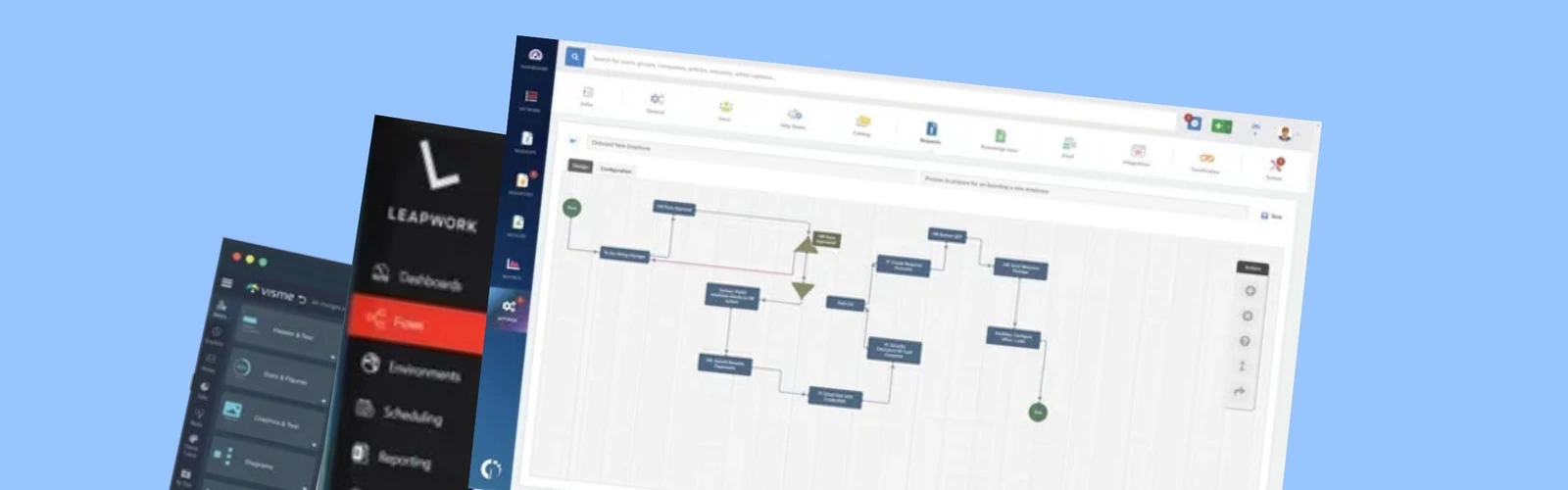
A Multi-Functional Business Process Management Platform for a Commercial Bank
Summary
INNERLUXES provided specialized front-end engineering to help a financial-IT software company deliver a large-scale business process management (BPM) system for a major commercial bank. Over a three-year engagement, INNERLUXES's front-end team built the interfaces for a BPMN 2.0 process constructor, an operations-management platform, an access-management app, and a network-bridge app.
About the Partner and the Bank
The Partner is a full-service IT company focused on the banking and financial services sector, with a portfolio spanning fintech solutions for banking operations management, customer self-service, biometric authentication, and document e-signing. Its client — the Bank — is a major commercial bank, one of the largest by asset volume in its domestic market.
Why the Partner Needed Specialized Front-End Engineering
The Bank engaged the Partner to develop a web-based business process management system comprising several BPM apps with task-specific features and interfaces — for banking operations management, business process modeling, automation-rule design, and access control. Building a tailored solution with rich visual representation of banking processes and intuitive workflow modeling for non-IT bank employees required specialized front-end skills. To avoid the cost of growing those skills in-house and to keep releases on schedule, the Partner chose to partially outsource the front-end work, and — having cooperated with INNERLUXES on banking software before and valued its banking IT expertise — brought our engineers back for the job.
Front-End Development for Task-Specific Banking BPM Apps
Within two weeks of the initial request, INNERLUXES provided a team of senior front-end developers experienced in custom BPM software. They began by studying the bank's business processes, the existing UX/UI requirements, and the wireframes from the solution-design team, then shared suggestions on optimizing user journeys and refining the look of the apps — advice the Partner found valuable and quickly adopted. After the design was approved, INNERLUXES moved to development, and over the following three years the front-end team helped deliver the components and features below.
A BPMN 2.0-Compliant Banking Process Constructor
INNERLUXES built feature-rich interfaces for visually modeling banking processes, configuring automation rules, and deploying them across the bank's systems. The team integrated the open-source Camunda Modeler library for ready-made flowcharting components and built a custom web UI on top of it to address the bank's specific needs, reducing custom code and speeding up development. Key front-end elements included:
- A drag-and-drop modeling interface for designing service processes — customer onboarding and profiling, AML/OFAC verification, account opening, credit-document validation and loan issuance, regulatory report filing, and more.
- A toolbar with a library of customizable process templates and reusable components (process diagrams, DMN decision tables, forms).
- A configuration panel to set properties of process elements such as transaction-processing sequences, approval hierarchies, decision rules, and account event triggers.
- A data-mapping panel to navigate and configure source data for automated operations.
- A process orchestration console to map rules and exception-handling for complex, non-standard banking scenarios.
- Comment and annotation widgets for collaboration on specific process elements.
- A simulation console to test modeled scenarios and surface potential issues visually.
- An integration interface to port designed processes and rules to connected banking systems, deploying to production directly or to a development environment first.
The constructor was built to the BPMN 2.0 standard, whose graphical notation is intuitive to both business and technical users — preventing misinterpretation of process models and streamlining their conversion to software logic.
A Banking Operations Management Platform
INNERLUXES developed the front end of the bank's low-code operations-management platform, with role-specific interfaces:
- Bank employee interface — customizable dashboards with task lists, statuses, activity history, and role-specific transactional journals and document registries; employees can file inter-department requests, generate documents and reports, monitor performance and bottlenecks, and (when authorized) configure process-automation rules.
- Auditor and regulator interface — lets external auditors, legal advisors, and regulators view the documents and transactional records needed to audit and verify compliance.
- Affiliate and partner interface — a panel giving the bank's branches and fintech partners access to banking information and data-sharing, with quick-search for easy navigation.
An Access Management App
INNERLUXES built access-control interfaces for the bank's security and servicing teams:
- Resource registries (SQL-database-like) showing banking resources — databases, apps, financial-service modules — and their access policies.
- Customizable role forms to create and modify user roles (financial analysts, customer-service specialists, underwriters, system admins) and assign access rights.
- User profile templates for adding and editing user information, roles, and role-based permissions.
- An access-request management panel showing requests, statuses, and decision-relevant data.
- An authentication management console to set authentication requirements per user and role, manage methods (email, SMS, dedicated apps), and configure notifications.
- User management dashboards with a detailed view of users, roles, access levels, and recent activity (successful and failed logins, permission changes, access requests, compliance statuses).
A Banking Network Bridge Management App
Working closely with the Partner's back-end developers and the bank's IT specialists, INNERLUXES created interfaces for managing communication between the banking system's server-side components and between the back end and external systems (legal registries, credit platforms). Through the app, network admins, DevOps engineers, and analysts can:
- Create and view back ends (transaction engines, app servers, databases, external registries) and connected endpoints (employee, customer, and partner devices).
- Map query-processing steps and data flows between back-end components.
- Configure network access gateways for endpoints.
- Configure default and backup connection protocols, query distribution and authorization flows, session timeouts, and back-end health checks.
- Monitor data flows ad hoc and via scheduled auto-reports based on event logs.
INNERLUXES's front-end developers collaborated with the Partner and the bank's stakeholders in two-week Agile sprints, continuously sharing ideas to improve the development process and the BPM solution's value.
Key Outcomes for the Partner
- Quick access to specialized front-end development competencies, enabling faster releases and minimizing the risk of delays.
- Eliminated cost of growing the missing front-end skills in-house, helping retain competitive rates and meet budget.
- High quality and value of the delivered BPM apps thanks to INNERLUXES's UX advice and domain-specific front-end skills.
Key Outcomes for the Bank
- Enhanced BPM-team productivity through prompt, intuitive design, modeling, implementation, monitoring, and adjustment of banking processes.
- Improved operational efficiency and simplified compliance with internal and regulatory rules through standardized, optimized operations.
- Streamlined digitalization of banking workflows, enabling an agile response to customer expectations and faster launch of new digital products.
Technologies and Tools
Angular, Redux, Material UI, Nginx, RxJS, dmn-js, NgRx, Nx, webpack, WebSockets, Camunda Modeler, SCSS, TypeScript.