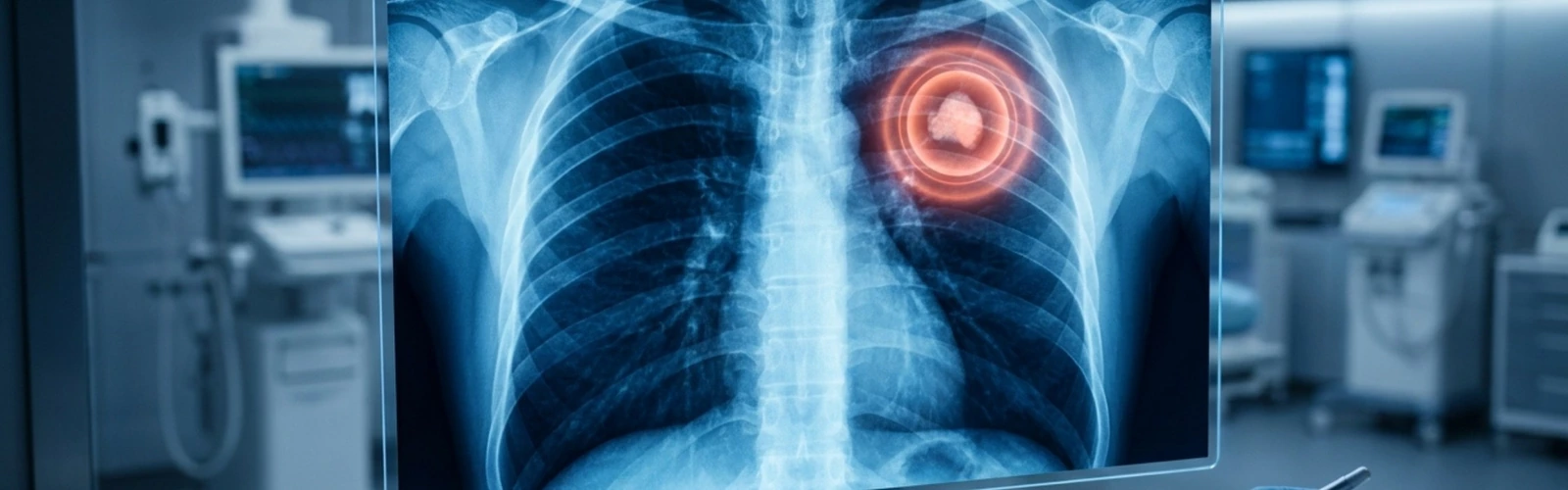
Desktop Diagnostic Applications for Flow Cytometry Analytics
Summary
We build desktop diagnostic applications that turn a validated flow cytometry classifier into software a laboratory technician can operate. Noninvasive tests for early-stage lung disease analyze cellular events measured by a flow cytometer and derive a diagnostic result from patterns in that data. Research teams develop the underlying classifier during validation trials, where it runs on a workstation under expert supervision. Diagnostic software is a different object entirely: it acquires instrument output and patient context automatically, produces a consistent report every single run, and carries the documentation required to place a medical device on the market.
The Challenge
Most of the work is not the algorithm. It is everything that has to surround the algorithm before it can be used on a patient sample. Reliability of report generation is the requirement that matters most, and it is threatened at the boundaries rather than in the mathematics: a truncated acquisition file, a missing message segment, an analytics runtime version drift, a locked file on a network drive. Each of those needs an explicit, tested behavior that stops the run with a clear message rather than producing a plausible wrong number. Regulatory evidence has to be produced during development, because documentation reconstructed afterwards will not satisfy an auditor, and every additional user-facing feature enters the regulated documentation set with it.
The Solution
Application structure
- A native desktop application with the core in C++, chosen because the workload is intensive numerical processing over large event files and predictable performance matters more than portability.
- An analytics bridge that invokes the existing statistical script with the acquisition file paths, captures its output and error streams, and validates the returned structure before anything is presented as a result.
- An acquisition watcher monitoring the secure network location where the cytometer deposits output for a completed run, handling partial writes so analysis never starts on an incomplete file set.
- A patient data interface receiving demographic attributes such as age from the laboratory information system, since those values feed the diagnostic computation and cannot be optional.
- A reporting component producing the report in a fixed, versioned layout, with a local record of inputs, algorithm version and result for later retrieval.
Interfaces and protected data
The clinical interface is HL7 messaging against the laboratory information system, used to pull patient context and to return results into the laboratory workflow. Message profiles vary between laboratories, so field mapping and acknowledgement handling need configuration rather than hard coding. Cytometer output arrives as standard event files whose channel layout depends on the panel used, and any run whose configuration does not match what the classifier was validated against is rejected. Everything touching patient identity is protected health information, so encryption, access control and audit logging sit inside the application scope even though it runs on a single laboratory computer.
Regulated lifecycle
Development takes place inside a quality management system certified to ISO 13485, with the software lifecycle following IEC 62304 and risk management following ISO 14971. In practice that means a documented software safety classification, requirements traced through design and test artifacts, formal verification records and controlled change management. Market access routes such as an FDA 510(k) submission or CE marking under the in vitro diagnostic regulation determine what evidence must exist. Where scope is fixed and requirements are rigid, a sequential lifecycle fits better than iterative discovery, because the documentation follows the same sequence. Verification covers unit-level tests of application logic and end-to-end runs against reference datasets with known expected outputs. The analytics runtime and its package versions are pinned, and the algorithm version is recorded in every report.
What This Delivers
A method that previously required an expert at a workstation becomes a routine laboratory procedure. Technicians run samples and receive an identically structured report each time, with patient context arriving automatically instead of being retyped, and results returning into the laboratory workflow rather than sitting in a local file. Invalid runs stop with an explanation instead of yielding a number that looks usable, and every report traces back to the inputs and the algorithm version that produced it.
Technologies and Tools
- C++ desktop core with an R or Python analytics runtime invoked through a validated bridge
- HL7 messaging to the laboratory information system
- Standard flow cytometry event files with panel configuration validation
- ISO 13485, IEC 62304 and ISO 14971 process, traceability and documentation tooling