Ecommerce Platforms Comparison – Top 10 for Any Business

since 2026, INNERLUXES has delivered end-to-end ecommerce services across 68 projects and 30+ industries. We sell no platform licenses and take no vendor commissions, so the nine platforms below are compared on merit alone.
What Is an Ecommerce Platform — and Why It Matters
Ecommerce platforms ship with pre-built architecture and functionality to launch an online commercial presence. Platform-based development cuts costs and accelerates time to market. Some vendors support every business model — B2C, B2B, and marketplaces — while others go deep on a single one. Choosing well shapes how you sell, how fast you grow, and how much it costs to evolve.
Features to Expect from a Robust Ecommerce Platform
Before you compare vendors, know what you should be getting. A solid platform covers all of this — if it is missing pieces, that is your first red flag.
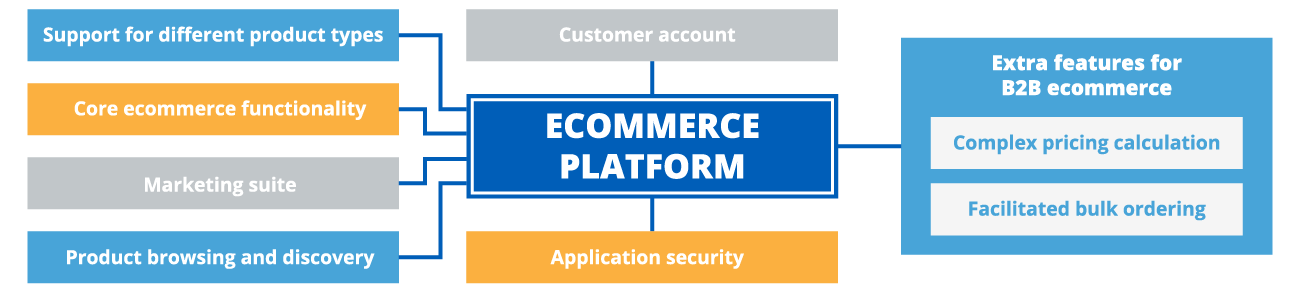
Support for different product types
- Simple product.
- Configurable product.
- Grouped product.
- Bundled product.
- Virtual product.
- Downloadable/digital product.
Core ecommerce functionality
- Core informational pages (e.g., Home, About Us, Privacy Policy).
- Product and catalog management.
- Shopping cart.
- Guest and registered checkout.
- Embedded payment gateways.
- Order and return management.
- Reporting.
- Web APIs for third-party integrations.
Marketing suite
- Online merchandising.
- Pricing and promotion management.
- Customer segmentation.
- SEO.
- Email marketing.
- Loyalty management.
- Social media integration.
- Content management.
- A/B testing.
Product browsing and discovery
- Layered navigation.
- Product filtering.
- Product description and attributes.
- Multiple images per product.
- Product stock availability.
- Product rating and reviews.
- Related products, upsells and cross-sells.
Customer account
- Saved personal, shipment and payment details.
- Order status and history.
- A reorder possibility.
- Wish list.
- Tracking of reward points.
- Personalized coupons.
- Newsletter subscription management.
Application security
- Secure admin access levels.
- Patching application vulnerabilities.
- Day-to-day infrastructure management.
- Automated data backup in case of incidents.
- PCI DSS compliance.
Extra features for B2B ecommerce
Complex pricing calculation
- Automated pricing rules.
- Volume-based pricing.
- Quotes for negotiated pricing.
- Custom catalogs with pricing available only to specified corporate accounts.
Facilitated bulk ordering
- Order export before submission.
- Quick reorder of previously purchased items.
- Multiple requisition lists per customer account.
- Minimum and maximum order volume storewide or by customer.
Top Ecommerce Platforms Shortlisted by INNERLUXES
We have evaluated the most popular and well-established online store platforms capable of delivering on ever-growing ecommerce demands. The order below is not a ranking — each platform wins in a different situation.

Adobe Commerce

Best for mid-to-enterprise market
Description
Open-source at heart, Adobe Commerce gives your team real freedom to build unique shopping experiences rather than configuring around someone else’s assumptions. It runs on AWS as a hosted SaaS but also supports on-premises and private cloud deployment.
Purpose-built for mid-sized and enterprise B2C and B2B operations with complex catalogs. The trade-off is real: that freedom costs developer hours, so budget for a capable development team from day one.
Pricing
From $800/month.
Salesforce Commerce Cloud
Best for enterprise market
Description
Separate B2C and B2B solutions, both strong on their own. The B2C product has AI built in and handles omnichannel selling well. The B2B product connects natively with the wider Salesforce ecosystem.
If your team already runs on Salesforce tools, this is a natural fit. If you need one platform running both models, note that B2B sits on the proprietary Lightning Platform and B2C does not.
Pricing
GMV-based — the vendor provides exact prices by request.

Dynamics 365 Commerce
Best for mid-to-enterprise market
Description
If your business already runs on Microsoft, Dynamics 365 Commerce integrates seamlessly across the suite — finance, supply chain, and customer service share one data model with the storefront.
Its flexible pricing model makes it compelling for mid-sized companies that want enterprise-grade omnichannel retail management without enterprise-sized commitments.
Pricing
- $180 per user/month for the omnichannel retail management platform.
- From $2,000/month for the ecommerce add-on.

Oracle Commerce
Best for enterprise market
Description
Built for businesses operating at serious scale. Pairs a dedicated ecommerce platform with tools covering digital marketing, loyalty programs, data intelligence, and content management.
One of the few platforms that handles B2C, B2B, and B2B2C comprehensively rather than bolting the second and third models onto the first. Expect an enterprise sales cycle and an enterprise budget.
Pricing
Depends fully on business requirements and requires contacting the vendor directly.

Shopify Plus
Best for small-to-middle market
Description
The go-to for teams that want to move fast without heavy technical overhead. No-code configuration tools make launching, testing, and iterating quick.
Native functionality has real limits at scale — many businesses end up relying on multiple third-party apps to fill the gaps, which adds recurring cost and a maintenance surface most buyers do not price in during evaluation.
Pricing
From $800/month, plus 0.15% per transaction when you use a third-party payment processor instead of Shopify Payments.

Episerver (Optimizely)
Best for middle market
Description
Sits at the intersection of ecommerce and content experience. Its Digital Experience Platform pairs a cloud-based ecommerce engine with content intelligence, personalization, and advanced analytics.
Ideal for brands where the content, not the catalog, is what converts. If your roadmap is mostly SKU growth rather than editorial depth, the extra suite is capacity you will pay for and not use.
Pricing
The license pricing varies depending on the number of SKUs listed. Exact prices by request.

BigCommerce
Best for small-to-midsize market
Description
BigCommerce punches above its weight. It targets smaller and mid-sized retailers but brings a solution portfolio covering B2C, B2B, and headless commerce without cutting corners.
Its multi-channel integration with major marketplaces and social platforms is particularly strong — often the deciding factor for merchants who sell in more places than their own storefront.
Pricing
Four pricing plans, starting from $29.95/month up to custom pricing for an advanced offering.

Sitecore DXP
Best for middle market
Description
The platform for experience-first businesses. If you have already invested in Sitecore’s DXP and want to extend into ecommerce, this is the obvious next step.
Includes a strong digital marketing suite with native digital asset management and product information management. Its ecommerce market share is modest, so vet the availability of Sitecore commerce developers before you commit.
Pricing
Depends fully on business requirements and requires contacting the vendor directly.

Intershop Communications
Best for middle market
Description
A European-origin platform with a strong global presence. Intershop serves mid-sized B2B companies primarily, with a modular approach covering digital commerce, product information, order management, and digital experience.
Its Commerce-as-a-Service model is genuinely unusual: the vendor takes on the role of the ecommerce service provider and delivers a turnkey environment designed around your requirements.
Pricing
Four price packages by request.
Criteria of Ecommerce Platform Comparison
The choice of an ecommerce solution is a crucial business decision. Since this page gives only a high-level description of each platform, here are the aspects to bear in mind when you compare them on your own.
Impact on business strategy and internal workflows
- SKU limit.
- Headless architecture.
- Functional limitations (native functionality, platform customizability).
- Ecommerce admin experience.
- Ready-made integrations covering core business workflows.
- Data analytics capabilities.
Business models supported
- B2C ecommerce.
- B2B ecommerce.
- A multi-vendor marketplace.
- A multi-store managed from the same back end.
- Mobile commerce.
Cost of ownership
- Platform licensing.
- Hosting and deployment models.
- Availability and average cost of platform developers and consultants.
- Support complexity.
- The platform roadmap and the frequency of new feature delivery.
If No Ecommerce Platform Really Suits Your Business
All the platforms listed have monolithic architecture, where the front end and the back end are tightly connected. You do get flexibility in website design, but fully custom front-end theme development is time- and cost-consuming, and it complicates design changes down the road. If you want full freedom to frame any kind of user experience, consider a custom headless ecommerce solution: the ecommerce functionality you need in the back end, built on any platform, with a decoupled presentation layer.
What Else Do You Need for an Ecommerce Launch?
Your implementation partner is as important as the platform you choose. From software development and 68 delivered projects, we know what ecommerce companies need and where things go wrong.
Ecommerce consulting
- Technology consulting – to choose the ecommerce platform in line with your roadmap and scalable for evolution.
- TCO analysis – licensing, hosting, implementation, developer rates, and support, costed before you commit.
- Strategy consulting – to shape the target audience and craft a powerful customer experience.
Ecommerce development
- Migration – to balance effectiveness and cost of ownership without losing data or SEO rankings.
- Website design and development, including architecture, UX and UI design, personalization, and checkout optimization.
- Integrations to automate all supporting business operations – ERP, CRM, PIM, payment providers, and carriers.
Ecommerce Platform Selection – Q&A
Which ecommerce platform is best for an enterprise business?
For enterprise businesses, Adobe Commerce, Salesforce Commerce Cloud, and Oracle Commerce are the leading options. The right choice depends on your business model (B2C, B2B, or both), existing tech stack, and scalability requirements. Our team helps you evaluate these against your specific roadmap.
What if no platform on the market suits my business needs?
If standard platforms do not fit, a custom headless ecommerce solution may be the right move. You get full back-end functionality on a platform of your choice, with a fully decoupled front end for complete creative freedom. INNERLUXES has built headless solutions across industries.
How do I calculate the true cost of an ecommerce platform?
Total cost of ownership includes licensing fees, hosting and deployment, customization and implementation costs, developer availability and rates, ongoing support complexity, and the platform’s upgrade roadmap. INNERLUXES provides a full TCO analysis before you commit to any platform.

About INNERLUXES
INNERLUXES is a US LLC · Pvt Ltd software company with 132+ IT professionals, and 68 delivered projects across 30+ industries. Quality and information security management run under robust internal management systems, and our engineers work inside a Chromium enterprise browser we built in-house, so client source code, credentials, and customer data never leave a controlled environment. Learn more about our ecommerce service offering, our named specialists, and our published client projects.