Adobe Commerce (Magento) as a Marketplace Platform for Multi-Vendor Ecommerce Business
INNERLUXES works with Adobe Commerce across diverse ecommerce business needs. We will help you build a robust multi-vendor marketplace solution based on this powerful platform.

Adobe Commerce as a Marketplace Platform: The Gist
Online marketplaces are the most profitable sales channel in ecommerce, generating almost a half of all online sales. No wonder ecommerce software vendors strive to cover the marketplace model, and Adobe Commerce is no exception. Though inherently a single-vendor platform, it serves well in a multi-vendor role too. What you need is a ready-made marketplace extension to convert Adobe Commerce into a multi-vendor marketplace.
This ability to keep pace with the ever-changing demands of ecommerce businesses and digital consumers has earned Adobe Commerce the status of a Leader in Digital Commerce according to such reputed market researchers as Gartner and Forrester.
Translate the right marketplace value to sellers
Launching a marketplace, you need to understand your competitive advantages and communicate them clearly to draw in sellers. With a marketplace powered by Adobe Commerce, you offer:

Services to enable ecommerce sales quickly
Including self-service product management, online merchandising, payment processing, and customer service. Warehousing, order management, and return handling may be either on the seller's or the marketplace's side.

High online traffic
You assume full ownership over customer acquisition and achieve vast customer outreach through advertising, SEO, and promotions.

Unmatched customer experience
Access to multiple brands, with the possibility to compare products and prices from multiple sellers.
Adobe Commerce multi-vendor marketplace: functional portfolio
Marketplace features for the owner
Streamlined onboarding of new sellers
With an intuitive process of marketplace account registration and automated notifications on account approval.
Commission management
To enable different commission rates for different sellers and product categories.
Analytics dashboards
Reporting on key marketplace metrics: GMV, average order value, customer acquisition cost, etc. The metrics can be tailored to your business needs.
Quick automated approval
Of products uploaded by sellers.
Restricted product categories
To protect consumers from fraudulent products and require licensing confirmation from sellers before approving them to sell.
Customizable product attributes
For different product categories and types.
A custom homepage
To ease customer navigation to top-selling products, trending product categories, best sellers, and current special deals.
Product recommendation techniques
To showcase a larger product assortment to customers and help conversions.
Marketplace features for sellers
A seller dashboard
To modify business information and manage business operations: products, orders, payments, sales analytics.
Role-based admin access
To delineate responsibilities of different team roles.
Editing an account URL
To make URLs SEO-friendly and easier to share.
Bulk product upload
To speed up time to market for new products.
Assisted inventory management
Notifications on low stock, a pre-order possibility, timed SKUs to go live upon restock.
Order management
Allowing sellers to receive, process, and ship their orders independently.
Marketplace APIs
To connect a seller's account to their business systems: e.g., OMS and PIM.
Integrating social media
Sellers can promote their social media presence and nurture a brand-loyal audience.
Access to customer-generated content
To view and respond to customer feedback and inquiries.
Marketplace features for customers
Multilingual support
To allow for shopping in the native language.
Faceted navigation
To help customers filter a wide-ranging product catalog and a seller list.
Contacting a seller directly
To get customer cases resolved promptly.
Concurrent checkout
With products from different sellers.
Access to a seller's page
With comprehensive brand information and a full product collection.
Streamlined checkout
With automated tax calculation for multiple sellers.

See Marketplace Functionality in Action
Explore our marketplace software overview to see the functional capabilities you will obtain in a marketplace solution and how they help you engage more sellers and make the digital user experience smooth.
Adobe Commerce marketplace integrations
To enable professional marketplace trading, you can create APIs and provide cross-system integration possibilities. It means that sellers will be able to connect a marketplace account to their business systems and enable data exchange between them. This is particularly important for omnichannel sellers.
The focus integration areas are inventory, product information management, order fulfillment, and analytics.
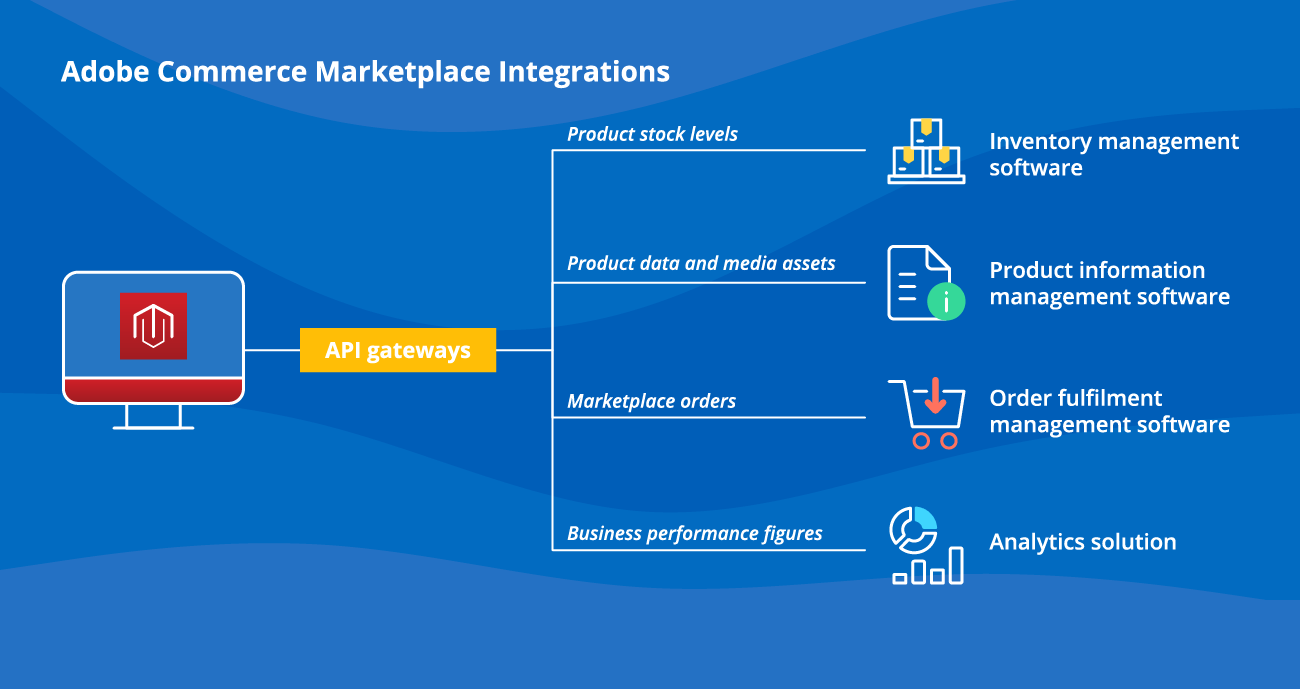
- Inventory API. Sellers upload product listings in bulk and sync stock levels across their sales channels.
- Product information management API. Sellers spread consistent product information across their sales channels.
- Order fulfillment API. Sellers maintain visibility into large volumes of omnichannel order data, manage different packaging and couriers centrally, and please customers with fast and accurate delivery.
- Analytics API. Sellers look deeper into sales performance, analyze the efficiency of their promotional initiatives, elicit seasonal trends, and understand the contribution of the marketplace channel to their revenue pipeline.
|
INNERLUXES is a reliable partner to businesses choosing Adobe Commerce as their ecommerce technology. Tasked to build a multi-vendor marketplace, we successfully shape it into the required solution, keeping focus on lasting security and high coding standards. |

Run the Numbers on an Adobe Commerce Marketplace Launch
How a marketplace model works for different product lines
With Adobe Commerce as marketplace software, you cater to the specifics of diverse shopping categories.

Consumer electronics

Furniture & Home décor

Beauty & Personal care

Apparel & Accessories

Mixed product assortment

Food delivery
Adobe Commerce multi-vendor marketplace: investment breakdown
The total cost of your marketplace launch is a sum of three components.
1
Adobe Commerce license cost
- Magento Open Source – free
- Adobe Commerce Starter – from $1,999/month
- Adobe Commerce Pro – from $3,999/month
* The final license cost depends on your gross merchandise volume.
2
Marketplace extension cost
Given the variety of marketplace solutions, INNERLUXES advises on the best-suited one upon the analysis of your business requirements and budget expectations.
3
Marketplace implementation cost
Depends on the design and implementation scope, integrations, and customizations you need. Check our pricing approach or contact us for a free, non-binding estimate tailored to your marketplace requirements.